Dime MTL: From Montreal Skate Crew to Global Streetwear Phenomenon
There are brands that make clothes, and there are brands that make culture. Dime MTL — officially just "Dime," but universally known by its Montreal postcode — belongs to the second category. What began in 2005 as a group of Montreal teenagers posting grainy skate clips to a website they rarely updated has become, by virtually every measure, the most vital skate brand on the planet. Not bad for a crew whose founding philosophy was, in co-founder Phil Lavoie's own words, "just for fun."
But "just for fun" doesn't explain sell-out drops that outpace Supreme, collaborations with adidas that feature actual tennis legend Stan Smith in a surreal promotional video, or a homegrown skate contest that draws 7,000 spectators to Montreal's IGA Stadium. What it does explain is how Dime built one of the most authentic and genuinely beloved brands in streetwear by never once pretending to be something it wasn't.
Shop the full Dime MTL collection at Gallery Streetwear
The Origin: Dimestore Crew, Boom-Bap, and Peace Park
In 2005, a crew of Montreal teenagers — Antoine Asselin, Phil Lavoie, Bob Lasalle, Hugo Balek, Charles Rivard, Eric Riedl, and Alexis Lacroix — began doing what skate crews have always done: filming each other, editing clips, and posting them online. The difference was the sensibility they brought to it. While most Canadian skate crews of the era were grinding to fit into the American scene — softening accents, copying Californian tricks, chasing Thrasher coverage — this group leaned hard into their Montreal identity.
Their videos were something you hadn't quite seen before: slick shredding interrupted by genuinely weird street moments, boom-bap hip-hop soundtracks, low-fi camera filters cut against zero-fucks-given iPhone clips. Peace Park — the outdoor concrete plaza at the heart of Montreal's skate scene — was their backyard and creative nucleus. They originally called themselves Dimestore Crew, a name that nodded to both the cheap-but-valuable nature of the operation and the 10-cent hustle of keeping skating alive through a Quebec winter.
The first batch of merchandise was exactly 100 t-shirts, printed at a local Montreal shop under the Dimestore Crew name. The second batch came out under the shortened name "Dime." Neither was intended as a serious commercial move — they were things to wear in their own videos, things to give friends. The brand was a byproduct of the crew, not the point of it.
That changed — partially — in 2010, with the release of The Dimestore Video. The full-length featured parts from Asselin, Lavoie, Lasalle, Ryan Decenzo, and other members of Montreal's skate community, packaging that same mix of humour and genuinely excellent skateboarding into something the broader skate world could absorb. By 2013's Turd Season video, the entire country of Canada was sending footage to the Dime crew. They were no longer just posting web clips — they were the standard-bearers for Canadian skateboarding.
Vincent Tsang and the Visual Language That Changed Everything
The defining turning point in Dime's transformation from skate crew to streetwear brand came in 2011, when they brought on Vincent Tsang. A Canadian blogger, retail expert, and photographer, Tsang was originally hired to help with web design. He never really left.
Tsang became Dime's art director and built one of the most distinctive visual identities in contemporary streetwear. The centrepiece is the logo: a cursive script that sits so close to the Dior wordmark it functions as a permanent wink at the fashion world's pretensions. Highsnobiety called it "a masterclass in understated branding" — immediately legible to anyone who knows, deliberately ambiguous to anyone who doesn't.
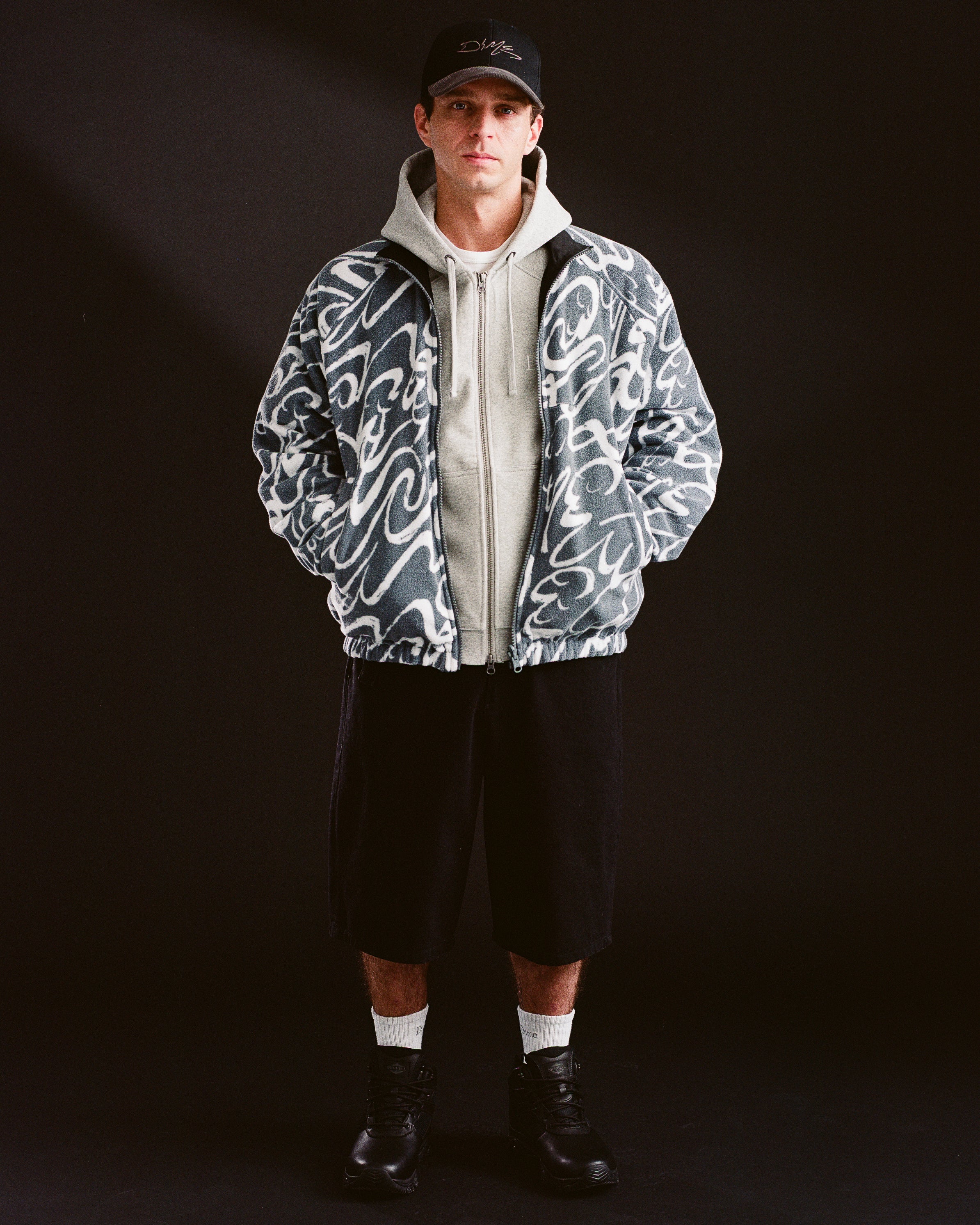
But Tsang's contribution went further. He established a visual grammar rooted in a signature wave motif (a debossed pattern that now appears across collaborations and apparel), a monochrome palette punctuated by clean archival colours, and a sensibility borrowed equally from '90s J.Crew catalogues and underground zine culture. Dime's lookbooks are so precisely shot — librarian glasses, crisp backdrops, models who look like they came from skating, not a casting agency — that they resemble retro skate magazines shooting glossy fashion editorials.
The graphics range from the subtle (the cursive logo alone on a heavyweight fleece) to the absurd (the "botched Jesus" painting that appeared on the tongue of their adidas Stan Smith collaboration, replacing Stan Smith's own portrait). The humour is always present but never cheap. By 2015, Dime had opened a proper retail store steps from Peace Park, stocking their own product alongside a curated selection of other brands — a reflection of how Dime has always seen itself as a cultural curator as much as a commercial operation.
The Dime Glory Challenge: Skateboarding's Greatest Spectacle
If you want to understand what Dime is, skip the lookbook and watch a Glory Challenge recap. The annual event — held each summer in Montreal and presented by Vans since its inaugural edition in 2015 — is the most chaotic, inventive, and genuinely joyful occasion in professional skateboarding. It is also, by every measurable standard of crowd response and cultural impact, one of the most important.
The Glory Challenge was born from a joke. The Dime crew landed on a question: "What if the whole crew flew to San Francisco to find Joe Valdez?" Joe Valdez is an obscure '90s skater known for riding impossibly skinny ledges who had been off the radar for over a decade. Dime actually flew to San Francisco, found Valdez, brought him to Montreal, named him chairman of the fictional "Dime Technology Center," and built the first challenge around a recreation of his signature move — a gap to flat bar that extends progressively wider until someone spectacularly eats it.
That first edition, held inside a Montreal warehouse with smoke-filled air and zero formal structure, set the template. No judges, no scoring criteria — just challenges designed to reward commitment, creativity, and willingness to do something genuinely stupid in front of a crowd that knows exactly how to appreciate it. The challenges change every year: a Volcano Challenge with a flame-spitting spine ramp, a Dodgeball Challenge where world-class skaters hurl balls at each other mid-trick, a Big Bank Challenge on a rail that looks like it belongs in a fever dream. The 2016 edition famously awarded $15,000 to Peter Hewitt specifically for finishing last.
By the time the event moved to IGA Stadium with 50 invited pro skaters and 7,000 fans in attendance, it had become something entirely distinct from every other contest on the calendar. The 2025 edition — the tenth anniversary, returning after a two-year hiatus — featured Ryan Sheckler, Tom Schaar, Pedro Barros, Ishod Wair, and Curren Caples. These are athletes who fly to Montreal specifically for the Glory Challenge because nowhere else offers elite skateboarding fused with the unrestrained spirit of a backyard session. Vans debuted the collaborative Era Stub sneaker on-site, completing a symmetry that defines the Dime ecosystem: the event produces the culture, the culture drives the commerce.
The Collaborations: Funny, Excellent, Usually Both
Dime's collaborative catalogue is absurdly stacked for a brand that spent most of its first decade insisting it wasn't really a clothing company. What distinguishes their collabs from the endless stream of co-branded product that clogs the streetwear calendar is consistency of approach: every collaboration is an opportunity to make something genuinely funny and genuinely excellent, simultaneously if possible.
Vans is Dime's closest and most enduring partner. The relationship — which includes presenting sponsorship of the Glory Challenge and over a dozen collaborative colourways across multiple silhouettes — reads less like a corporate arrangement and more like what happens when two brands actually share a worldview. The 2025 Dime x Vans Era Stub took the classic Era, one of skating's most iconic shoes, and made one apparently simple modification — shifting from five lace loops to eight, shortening the toe box, changing the proportions entirely.
New Balance arrived in 2020 with the 860 v2 — a technical runner (notably not a skate shoe) released in navy/yellow and silver/white at $165 CAD. The choice of silhouette was deliberate. Dime's audience had expanded well beyond core skaters, and the 860 v2 signalled an appetite for archival athletic footwear that premium streetwear had adopted. It sold through immediately and established Dime's credibility in the broader sneaker world.
adidas entered the conversation in 2023 with the Superstar ADV capsule, and the relationship has since produced some of the most discussed collaborative campaigns in recent streetwear memory. The 2024 Stan Smith drop featured Dime's signature wave pattern debossed across the upper, the botched Jesus painting replacing Stan Smith's portrait on the tongue, and — most memorably — a promotional video starring Stan Smith himself alongside Darude performing "Sandstorm" while tennis players used skateboards as rackets. Beyond the Stan Smith, adidas and Dime have collaborated on the Busenitz, the Superstar ADV, and the Ayoon slides.
The extended roster of footwear partners — Reebok, Asics, Merrell, DC — speaks to a brand that other companies genuinely want to be associated with. Not for reach, but for the creative credibility that can't be manufactured at any marketing budget.
From 100 T-Shirts to a Global Force
Dime's rise from a 100-shirt run at a local Montreal print shop to a globally distributed brand with stockists across North America, Europe, Japan, and — as of 2025, the brand's 20th anniversary — China, is not a story of marketing strategy or investor rounds. It is a story of an audience that grew because the product never compromised.
The brand's early online presence attracted figures from well outside the skate world. Virgil Abloh, Kaytranada, and Lily-Rose Depp were among the first non-skate figures to visibly embrace Dime in the mid-2010s — not because Dime went looking for them, but because the brand's aesthetic was genuinely interesting to anyone with taste. That crossover happened without a PR strategy, and it created a stratified fanbase: core skaters who'd been there since the first web clips, sneaker collectors who discovered Dime through their footwear collabs, and fashion-adjacent consumers who simply responded to the lookbooks.
Highsnobiety named Dime the world's most vital skate brand in 2024, noting sell-through rates that outpaced Stüssy, Palace, and Supreme — a comparison that would have seemed absurd a decade earlier. The brand operates a drop model that generates genuine scarcity without the manufactured hype mechanics that have come to feel hollow in the post-Supreme era.
The Dime Aesthetic: What Makes It Work
Understanding Dime's design philosophy requires understanding what it is not. It is not Supreme's red-box maximalism. It is not Palace's aggressive graphics or Polar's fine-art references. Dime's aesthetic is something more elusive: impeccable taste deployed with complete nonchalance.
The clothing skews toward heavyweight basics — premium fleece hoodies, crewnecks, sweatpants — executed with the fabric weight and construction quality that justifies the price. Graphics appear when they need to, and only then. The cursive logo alone on a chest is enough. When a graphic tee arrives, it earns attention through specificity: a reference that rewards knowledge, a visual joke that lands better the more you think about it. The colour palette shifts seasonally but stays close to the core — washed neutrals, archival greens, bone whites, blacks that don't go grey after three washes. Fits are relaxed without being shapeless, a distinction that requires more thought than most streetwear brands give it.
How to Style Dime: Three Fits From the Gallery Collection
Dime's design philosophy makes styling their pieces genuinely straightforward, because the clothes carry an outfit without demanding to be the only thing in it. Here are three approaches that work with the Dime MTL pieces available at Gallery Streetwear.
The Monochrome Stack. Pair the Dime MTL Cursive Logo Sweatpants in black with the Dime MTL Cursive Small Logo Hoodie in black for a matching set that reads elevated rather than lazy. Dime's execution — understated branding, quality fleece, clean silhouette — is what separates this from generic co-ord territory. Ground it with a white low-top sneaker and you're done.
The Classic Canadian Weekend. The Dime MTL Cursive Small Logo Tee in white is one of those foundational pieces that works with almost anything. Tuck it into relaxed denim or cargo pants, layer a zip-up windbreaker over top, finish with a clean mid-top. This is the quiet fit that Dime's lookbooks endorse: effortless, proportionally sound, and readable from across the block without advertising itself.
The Elevated Skate Fit. Take the Dime MTL Cursive Logo Sweatpants in grey — more versatile than black for building out a rotation — and pair with a graphic tee underneath a Dime crewneck. Add well-broken-in skate shoes and a 5-panel cap. This is how Dime's own team skates, and it's the cleanest argument for why the brand's clothing translates from video parts to real life.
Shop the full Dime MTL collection at Gallery Streetwear to see all current colourways and styles in stock.
Why Dime Matters Now
Streetwear has spent the better part of a decade chasing legitimacy — collaborating upward, adopting luxury pricing, courting fashion week coverage. Dime has spent that same decade doing the opposite: staying in Montreal, staying close to skating, trusting that the work would speak for itself. The paradox is that this has made Dime more culturally legitimate than nearly any of the brands that pursued legitimacy directly.
At 20 years old, Dime is not a heritage brand coasting on nostalgia. They are actively releasing some of the most compelling product in streetwear, running the most entertaining event in skateboarding, and collaborating with partners whose teams actively seek them out. The cursive logo is now recognisable in Tokyo, Seoul, Copenhagen, and Beijing. Peace Park is still their backyard.
That is the real story: a crew of Montreal teenagers who wanted to skate and make videos ended up creating the template for how a skate brand can grow without selling its soul. No venture capital. No rebrand. No move to New York. Just very good clothes, very good skating, and a decade of the funniest contest in professional skateboarding.
Shop the full Dime MTL collection at Gallery Streetwear — Kelowna, BC's authorized Canadian Dime MTL retailer. Gallery carries hoodies, crewnecks, sweatpants, tees, caps, and skate decks, with free shipping across Canada on orders over $150.
Frequently asked
Where can I buy Dime MTL in Canada?
Gallery Streetwear is an authorized Canadian Dime MTL retailer based at 588 Bernard Ave in Kelowna, BC, and ships Dime MTL Canada-wide. You can shop in person in downtown Kelowna or order online at gallerystreetwear.ca. Free tracked shipping on Canadian orders over $150 CAD.
Where can I buy Dime MTL in Kelowna?
Gallery Streetwear carries Dime MTL at 588 Bernard Ave in downtown Kelowna, BC. The shop is open Tuesday to Saturday 11am to 6pm and Sunday and Monday 12 to 5pm Pacific. Local pickup is available at 588 Bernard Ave in downtown Kelowna.
Where is Dime MTL from?
Dime, universally known as Dime MTL after its Montreal postcode, began in 2005 as a crew of Montreal teenagers filming skate clips. Founders included Antoine Asselin, Phil Lavoie, Bob Lasalle, Hugo Balek, Charles Rivard, Eric Riedl, and Alexis Lacroix. Peace Park was their creative nucleus.