
There is a certain poetry in the arc of New Balance. For decades, the brand was the punchline — the sneaker your dad wore to mow the lawn, the shoe that screamed suburban parking lot rather than Supreme drop queue. Steve Jobs wore them every day, which was either the most damning or most prophetic endorsement in sneaker history, depending on when you were paying attention. Today, New Balance is reporting record-breaking global sales of $7.8 billion in 2024 — a 20% increase year over year, and the fourth consecutive year of 20-plus percent growth. At Paris Fashion Week, designers debut NB collaborations on the runway. Resellers flip pairs for double retail. And a new generation of streetwear heads — the same ones who used to clown the grey 990 — are lining up around the block for them. This is not an accident. It is the result of 118 years of stubborn commitment to craft, a handful of game-changing cultural partnerships, and a brand identity so authentic that hype culture eventually came around to meet it.
1906: A Chicken Foot in Boston
On April 24, 1906, an Irish immigrant named William J. Riley founded the New Balance Arch Support Company in the Boston area. He was not making shoes — he was making arch supports, flexible inserts inspired by the three-pronged anatomy of a chicken's foot, which Riley believed was nature's model of perfect balance. He reportedly kept a chicken foot on his office desk to demonstrate the concept to prospective customers.
The company grew slowly through word-of-mouth. Arthur Hall became a partner in 1934; his daughter Eleanor introduced the Trackster in 1960 — widely regarded as the world's first running shoe offered in multiple widths, quickly adopted by track teams at MIT, Tufts, and Boston University. Then in 1972, a 28-year-old entrepreneur named Jim Davis bought the company on Boston Marathon day. Six employees. A mail-order catalogue. A gut feeling that leisure-time products were about to explode. He was right. As the American running boom accelerated through the 1970s, Davis made the decision that would define New Balance forever: he kept manufacturing in the United States, while every competitor chased cheaper labour overseas.
Made in USA, Made in UK: Why the Factories Still Matter
In an industry that has almost universally outsourced production, New Balance's domestic manufacturing stance is its most powerful differentiator. Today, NB owns five athletic footwear factories in New England (Maine and Massachusetts) plus one in Flimby, Cumbria, UK, investing over $155 million in U.S. production capacity expansion. Footwear marked "Made in USA" must carry a domestic value of 70% or more.
The Flimby factory — a coastal Lake District town in Cumbria — has been running since 1982, now employing over 200 skilled craftspeople producing 6,500 to 7,000 pairs per week, all by hand. Prince Edward visited in May 2011 and specifically acknowledged NB's commitment at a time when British manufacturing had largely vanished. This matters to sneaker culture for a simple reason: you cannot fake it. The stitch quality, the suede weight, the construction of a Made in USA 990 or Made in UK 991 is palpably different from a mass-produced runner. Collectors feel it immediately. It is the crown jewel of New Balance's portfolio — and the foundation upon which Teddy Santis would build an empire.
The Key Silhouettes: A Brief History of New Balance's Greatest Hits
The 990 — The Original $100 Shoe (1982)
In 1978, NB's R&D team asked Jim Davis for total creative freedom — no budget, no timeline. Davis said yes. Four years later, the New Balance 990 became the first sneaker ever to retail for $100 — the Air Jordan 1 would debut three years later at $65. The marketing line: "On a scale of 1000, this shoe is a 990." Davis projected 5,000 pairs. It sold ten times that in the first six months. Made in the USA from day one, built on a slip-lasted suede-and-mesh upper with an early ENCAP midsole, the 990 became a cultural artifact by the 2000s — worn by Princess Diana, Bill Clinton, and Steve Jobs, whose grey NB 990-series shoes were as inseparable from his uniform as Levi's 501s and Issey Miyake turtlenecks.
The 550 — Forgotten Basketball Shoe, Modern Icon (1989)
Designed by the prolific Steven Smith, the New Balance 550 debuted in 1989 as a low-top basketball shoe — a clean, perforated leather silhouette New Balance called the "P550 Basketball Oxford." Without a signature athlete and without the visual drama of Nike Air cushioning or Reebok pumps, the 550 quietly faded from shelves and disappeared from the catalogue entirely. For nearly three decades it existed only in the pages of vintage Japanese sneaker magazines — until Teddy Santis found it there, and the rest is history covered in the section below.
The 574 — The People's Shoe (1988)
Released in 1988, the New Balance 574 is arguably the brand's most universally recognised silhouette. Wider than the narrow racing shoes of its era, with a suede-and-mesh upper and ENCAP cushioning, the 574 was designed for runners and immediately claimed by everyone else. Its accessible price and clean proportions made it the entry point for millions of people who grew up wearing New Balance without quite knowing they were wearing New Balance. The 574 is the backbone — the model that introduced the brand to generation after generation of new fans before the 990 or the 550 ever had the chance.
The 327 — A '70s Archive Reimagined (2020)
The New Balance 327 is a masterclass in archive reinterpretation. Designed by Manchester-based NB designer Charlotte Lee, it debuted in April 2020 via a collaboration with Charaf Tajer's French-Moroccan label Casablanca — first unveiled on the Paris Fashion Week FW20 runway. It draws design DNA from three 1970s NB runners: the 320 (1976), the 355 (1977), and the SuperComp (1977). The oversized "N" logo was Lee's deliberate tribute to the brand's 1976 origins. "I don't think anything could have prepared me for the demand," Lee later said. The 327 was not a retro: it was a new silhouette that felt like a memory, and the market responded with immediate and overwhelming demand.
The 2002R — The Sleeper Hit (2010/2021)
The original New Balance 2002 arrived in 2010 as a $250 Made in USA lifestyle runner — too premium for mainstream adoption, and it faded quietly. A decade later, Salehe Bembury put the retooled 2002R back on the map with his "Peace Be The Journey" collaboration (October 2020), inspired by Antelope Canyon and rendered in earthy burnt orange, yellow, and maroon hairy suede. His 2021 follow-up, "Water Be The Guide," channelled Havasu Falls in teal and shaggy blue suede. Between those two drops and a series of well-timed general releases, the 2002R became one of the most wanted runners of its era — proof that the right collaborator on the right silhouette can resurrect anything.
Aimé Leon Dore x New Balance: The Partnership That Changed Everything
If there is a single turning point in New Balance's cultural ascent, it is the relationship between the brand and Aimé Leon Dore (ALD) — the New York label founded in 2014 by Teddy Santis, a Queens-born designer of Greek descent who blends NYC street culture, basketball, hip-hop, and Mediterranean heritage into something that feels completely its own.
The collaboration began in April 2019 with two colourways of the 997 that landed on year-end best-of lists. More 99X models followed — the 990v2 and 990v5 in late 2019, the 827 pack in early 2020, the 1300 in August 2020. Each release landed. Each one built credibility for what came next.
Then came October 2020 and the ALD x New Balance 550 — and nothing was the same afterwards.
Santis had spotted the forgotten 550 in a vintage Japanese catalogue. The silhouette's original blueprints had been lost — NB's design team flew to Japan to locate a collector with an original pair, deconstructed it, and rebuilt it for production. What emerged was a four-colourway pack in white leather with accents of navy, red, grey, and green, finished in a deliberately aged vintage treatment. The release caused a scene on Mulberry Street in Nolita — NYPD shut down the in-store drop. Pairs immediately hit double retail on the secondary market.
The 550 re-entered New Balance's permanent lineup in 2021 and has not left. It became the sneaker every celebrity from Kendall Jenner to Justin Bieber was photographed in — a modern classic that belongs to no single subculture.
On April 5, 2021, New Balance announced Teddy Santis as Creative Director of New Balance MADE in USA, effective 2022 — a first-of-its-kind role at the brand. His inaugural collection launched in June 2022 with the Made in USA 990v1, 990v2, and 990v3. Santis called it "the soul of the brand." CMO Chris Davis described Made in USA as "the lifeblood of our brand's authenticity in global style — the physical manifestation of what makes our brand unique."
The Collaborator Roster: A Who's Who of Streetwear's Finest
The ALD partnership opened a door, and New Balance walked through it with purpose, assembling a collaborator roster that no other brand in the world could match for diversity and authenticity.
JJJJound, the Montreal-based creative studio founded by Justin Saunders, began its NB partnership in November 2018 with an earth-tone 990v3. Their 2020 take on the 992 — forest green and brownish-grey — is a holy grail of the collab era. The formula is pure minimalism: no noise, premium materials, Made in USA construction, earth tones that look better with age.
Joe Freshgoods (Joe Robinson), the Chicago-based designer, has built what SoleSavy called "the best five-year run ever" in NB collaboration history. It began with "No Emotions Are Emotions" in 2020 — a 992 and OMN1S pack at NBA All-Star Weekend in Chicago, where fans lined the block in single-digit temperatures for roughly 800 pairs. His drops are always personal: "Outside Clothes" (990v3, 2021) referenced the East Coast street credibility of the grey 990; "The 1998 Pack" was a letter to his younger self. By his 12th collab — 2026's 1890 two-pack inspired by 1990s hip-hop music videos — Freshgoods had become the most prolific NB collaborator alive.
Salehe Bembury, former VP of Men's Footwear at Versace, brought nature-documentary storytelling to the 2002R. "Peace Be The Journey" (October 2020) was Antelope Canyon in burnt orange and maroon hairy suede; "Water Be The Guide" (June 2021) was Havasu Falls in teal and blue shearling. Bembury typically designs the narrative before he even knows which shoe he's working on — and it shows.
Stüssy arrived in 2017 with a limited-edition 990v4 in monotone cream — Stüssy branding only on the insole. When two of America's most legacy-driven brands operate in the same register of quiet confidence, the result speaks for itself.
From Dad Shoe to the Most Wanted Sneaker on Earth
The honest answer is that New Balance never changed. The world changed around it. NB's collaborations had long circulated in tight collector circles in Japan, Europe, and the I-95 corridor. Around 2018, the "dad shoe" moment arrived — chunky utilitarian runners suddenly read as authentically anti-hype. But the trend alone was not the whole story. The real move was CMO Chris Davis flipping the brand's marketing from 70% direct response to 70% brand building, bringing in collaborators whose storytelling reached audiences NB had never spoken to before. NB reported media impressions for collabs up 200% from early 2021 to early 2022; StockX reported 200% trade growth in that same window. Harris Poll Q4 2024 data placed NB first on its Gen Z Brand Tracker — an 18.3% brand equity lift in a single quarter. The 327 debuted on the Paris Fashion Week FW20 runway via Casablanca; Mowalola debuted an NB collab at Paris SS23; Auralee has continued the tradition since.
New Balance vs. Nike and Adidas: A Different Game Entirely
New Balance's approach is structurally different from Nike and Adidas — and increasingly legible as a strength. Nike's SNKRS and Adidas's Confirmed app built infrastructure for hype-driven drops, but both brands have faced years of consumer frustration with bots and artificial scarcity. An internal Nike meeting leaked by Complex in October 2021 reportedly revealed the company growing worried about losing customers to independent brands, New Balance among them. New Balance has no SNKRS equivalent; CEO Joe Preston refused to set DTC targets internally; the brand stayed selective on distribution and never went on sale. Average selling price has risen 30%+ over five years. "We're just not concerned with our competition. We carve our own path," Chris Davis told Complex. The numbers support him: four consecutive years of 20%+ growth, $7.8 billion in revenue in 2024, and a target of $10 billion — all while remaining privately held.
How to Style New Balance
The shoes do the heavy lifting — your job is not to overthink it.
990v6 Technical Hiker: Grey or olive Made in USA 990v6 + Gramicci G-pants (the articulated inseam and relaxed fit were made for each other) + a quarter-zip fleece or light shell. This reads at a trail junction and a specialty coffee bar. No socks above the ankle.
550 Prep-Street: ALD x NB 550 in navy or green + relaxed straight denim + a crewneck from Dime, whose quiet irreverence matches the 550's energy exactly + bomber or varsity. This is the outfit Teddy Santis essentially invented. It works because the 550's clean low-top leather silhouette elevates whatever you put above it.
327 Colour-Forward: The 327's oversized N and bold palettes can handle a louder fit. Earth-toned or rust Gramicci shell pants + graphic tee or printed flannel + relaxed overshirt. The 327's retro profile anchors a fit that would look chaotic with almost any other shoe.
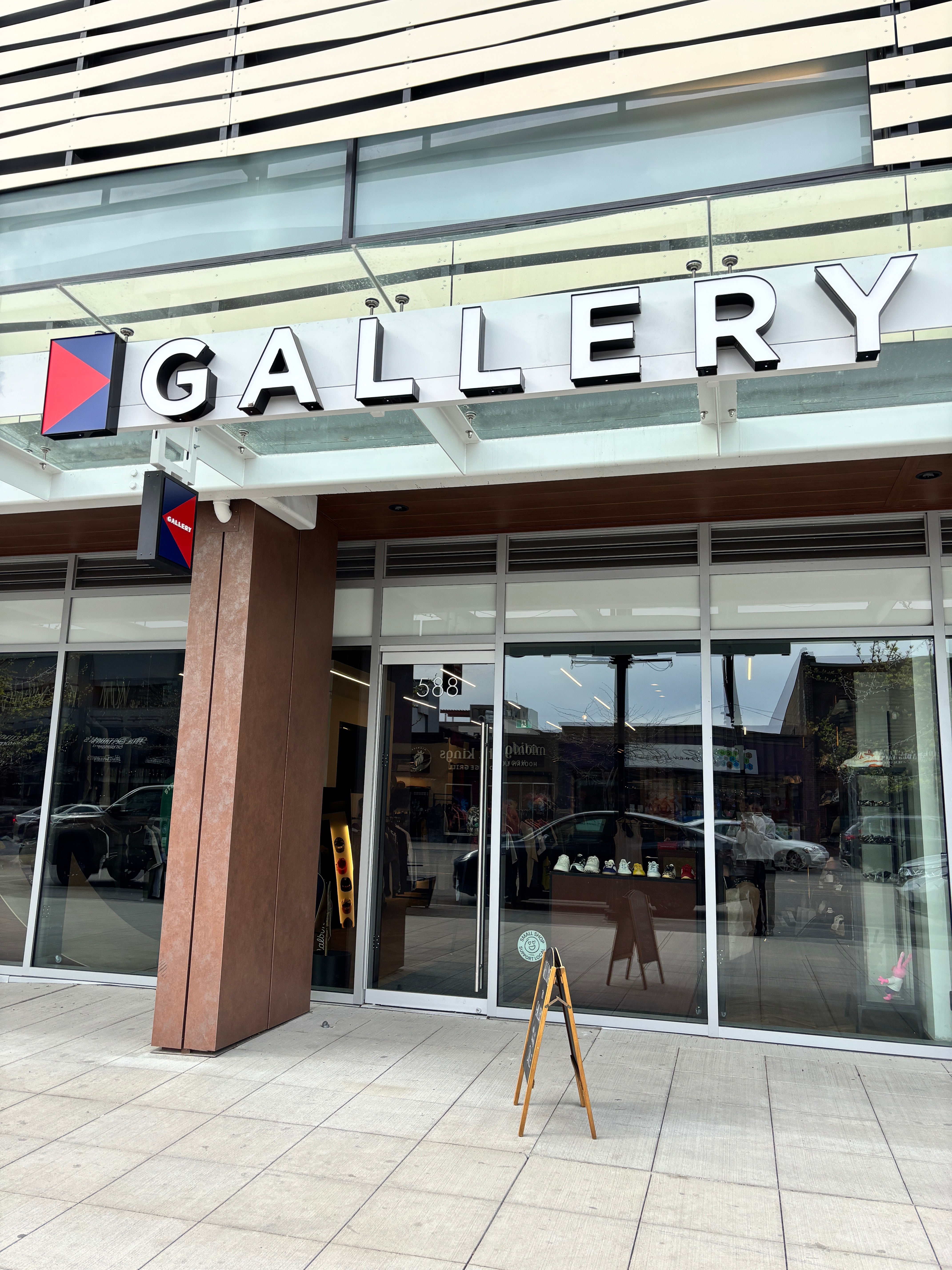
Shop New Balance at Gallery Streetwear
New Balance's rise is one of the great brand stories in modern retail — built not on manufactured hype but on 118 years of genuine craft, an unwillingness to cut corners, and the intelligence to partner with collaborators who understood what the brand already was before anyone else was paying attention. The 990, the 550, the 574, the 327, the 2002R: each one a different entry point into the same story. If you are ready to find your entry point, browse the full New Balance collection at Gallery Streetwear.
Gallery Streetwear is an authorised New Balance retailer serving Kelowna, BC and the Canadian market. To be straight with you about what is actually on our shelves: we do not carry the 990, in any version. What we do stock is the 9060 — our deepest run, currently seven colourways — plus the 1906R, 1906F, the 1906L Loafer, the 574, the 204L, ABZORB 2000 and ABZORB 2010, the 740, the 880R, the BB950, the Hierro v9 GORE-TEX, the RC42 and the 1906W. The 550 we carry is women's only, in Angora/Copper and Sea Salt/Peach Nectar. Shop New Balance at Gallery Streetwear — new arrivals land regularly, and the live collection page is always the accurate answer on what is in stock today.
The brand once dismissed as hopelessly uncool turned out to be the only one that was never chasing cool in the first place. That, as it turns out, is the coolest thing you can possibly be.
Frequently asked
Where can I buy New Balance in Canada?
Gallery Streetwear is an authorized Canadian New Balance retailer based at 588 Bernard Ave in Kelowna, BC, and ships New Balance Canada-wide. You can shop in person in downtown Kelowna or order online at gallerystreetwear.ca. Free tracked shipping on Canadian orders over $150 CAD.
Where can I buy New Balance in Kelowna?
Gallery Streetwear carries New Balance at 588 Bernard Ave in downtown Kelowna, BC. The shop is open seven days a week: Monday 12-5, Tuesday and Wednesday 11-6, Thursday to Saturday 11-7, and Sunday 12-5 Pacific. Local pickup is available at 588 Bernard Ave in downtown Kelowna.
Who founded New Balance?
New Balance was founded on April 24, 1906 by Irish immigrant William J. Riley as the New Balance Arch Support Company, near Boston. Riley modelled his flexible arch supports on the three-pronged anatomy of a chicken's foot. Jim Davis bought the company in 1972.